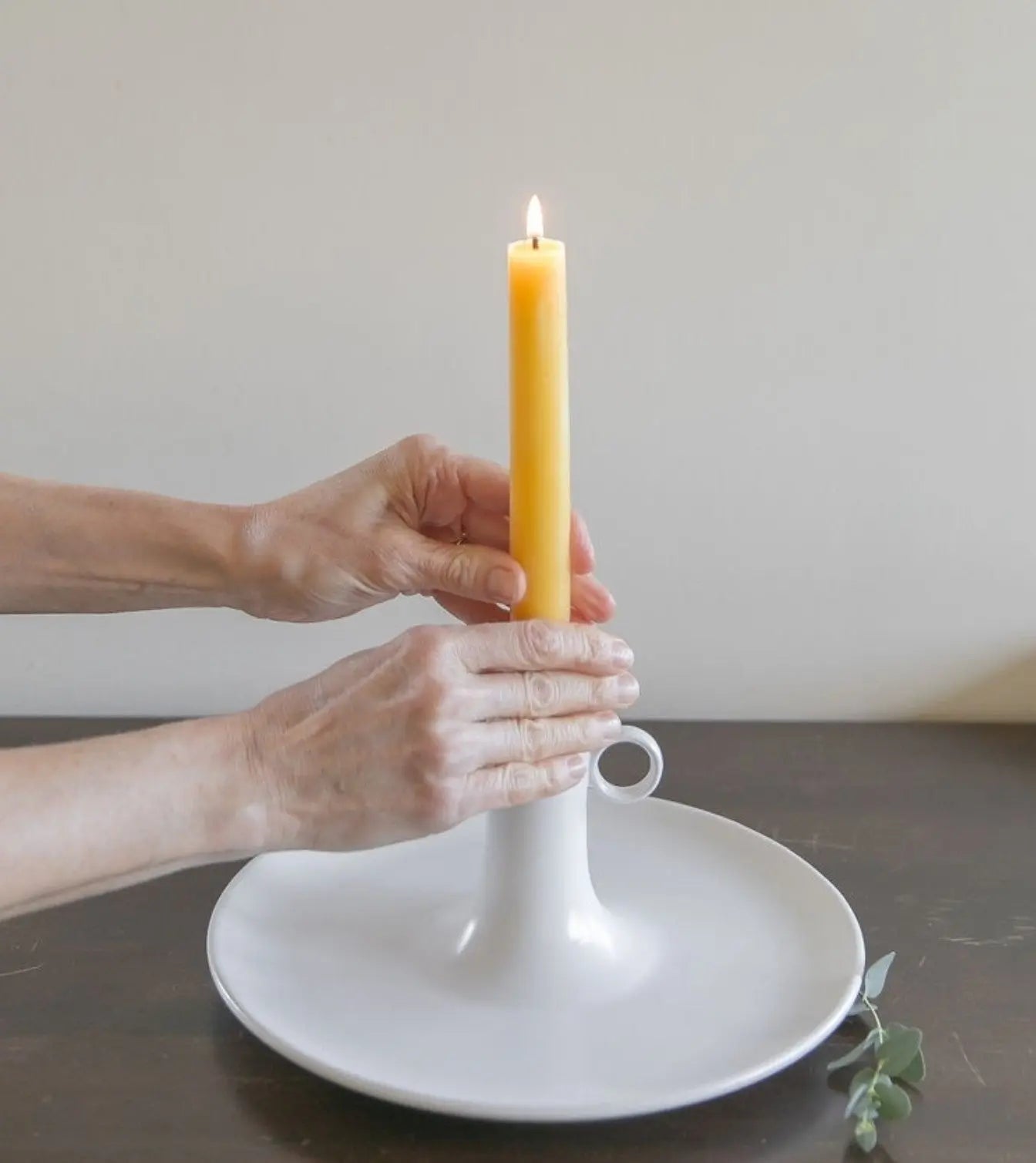


Katie Metka / Laberia Farm Candle Bundle
Katie Metka / Laberia Farm Candle Bundle
Couldn't load pickup availability
Shipping & Delivery
Shipping & Delivery
Canada
Free shipping on orders of $125 CAD or more, with tracking. Other shipping options and rates are shown at checkout.
United States
Free shipping on U.S. orders of $125 USD or more. Duties, import taxes, and brokerage fees are not collected by Beeswax Works at checkout; the carrier bills them separately, and the customer is responsible for paying them.
Shipping to the United States
Returns, Refunds & Order Help
Katie Metka / Laberia Farm Candle Bundle
Bring a nature-inspired Canadian beeswax collection into your home with this special collaboration between Beeswax Works and Katie Metka of Laberia Farm. Eight hand-poured candles create a generous mix of sculptural décor, everyday glow, and table-ready candlelight.
What’s included
- Rustic Fern Globe Candle: real fern impressions with 30+ hours of burn time.
- Spruce Tree Candle: an evergreen design with approximately 25 hours of burn time.
- Sweet Heart Candle: a hand-poured heart with approximately 5–7 hours of burn time.
- Narrow Three Inch Pillar: a classic slim pillar with approximately 20–25+ hours of burn time.
- Vintage Bee Globe Candle: a honeybee design with 18+ hours of burn time.
- Fir Cone Candle: a nature-inspired design with 22+ hours of burn time.
- Flat Top Three Inch Pillar: a versatile pillar with 40+ hours of burn time.
- 10-inch Hand-Dipped Beeswax Taper Pair: two dinner candles with 10+ hours of burn time each.
Bundle value
Enjoy an individual value of $153 CAD for a bundle price of $139 CAD. Each candle is made with pure Canadian beeswax and crafted with care in British Columbia.
Candle care
Trim the wick before lighting. Place each candle on a stable, heat-safe surface away from drafts, and never leave a burning candle unattended.
Meet the collaborator
Explore Katie Metka and Laberia Farm: Instagram, website, and YouTube.
Candle care and burn time
Candle care and burn time
Trim the wick to about 5 mm before every burn. Burn for two to three hours at a time so the wax pools evenly to the edge, and keep the candle away from drafts, fans and open windows.
Pure beeswax has a naturally high melting point, higher than soy or paraffin. That is why these candles hold their shape in a warm room and burn slowly rather than racing down, which is where the long burn time comes from.
A pale bloom may appear on the surface over time. It is a sign of unrefined, unbleached beeswax. Buff it with a soft cloth or leave it, as you prefer.

A beeswax candle rewards a little attention. Four small habits are the difference between a candle that burns clean to its edges for its whole life, and one that tunnels, smokes and quits early with half the wax still in it.
None of this is complicated. Here is everything, shortest version first.
Get these four right and the rest follows
1. Give the first burn time. Let the melted pool reach the full width of the candle before you put it out.
2. Trim the wick to a quarter inch. Before every light, not occasionally.
3. Keep it out of the draft. A calm flame burns evenly. A flickering one is wasting your candle.
4. Dip the wick to put it out. No smoke, no smell, and the wick is ready for next time.

That is the whole of it. If you read nothing else, you now know more about burning beeswax than most people.
Why it is worth bothering
Three honest reasons.
You paid for all of the wax. A tunnelled candle can leave a third of itself behind, stuck to the sides. That is money still sitting on the shelf.
Soot travels. An untrimmed wick or a drafty spot produces soot, and soot does not stay near the candle. Over a season it settles on walls, ceilings and curtains, and it is genuinely difficult to clean. Well-burned beeswax gives very little. Badly burned wax of any kind gives plenty.
It is an open flame. Worth a moment's thought in a house with children, pets, or anything that can catch.
We would rather tell you this plainly than have you assume a candle is a candle.
1. The first burn sets the pattern
The first time you light a candle, it learns a shape. Wax has a memory: the melt pool reaches a certain width, and every later burn tends to follow the same edge.

So on that first light, give it time. Let the pool of melted wax spread all the way out to the sides before you put it out. For a wide pillar that may be a couple of hours; for a taper, far less.
Cut the first burn short and the candle will burn straight down the middle from then on, leaving a wall of unburnt wax around a deepening hole. That is tunnelling, and it is much easier to prevent than to fix.
If you only have twenty minutes, it is better to light it another day.
2. Trim the wick, every time
A quarter of an inch, before every single burn. Tapers can take slightly more.
Nearly every candle complaint traces back to this one thing. A long wick draws up more wax than it can burn cleanly, so the flame grows tall and restless, the tip smokes, and soot lifts into the room. A short wick gives a small, steady, bright flame that burns the wax completely.
Cool the candle first, then trim. Scissors work. A wick trimmer works better, because it reaches into a deep pillar without you putting your hand in, and it catches the trimming instead of dropping it into the wax.

Wick Trimmer · Wick Trimmer & Dipper Box Set
3. Mind the draft
A candle wants still air. Keep it away from open windows, doorways, fans, and heating or cooling vents.
Moving air pushes the flame sideways. The candle then burns down one side rather than evenly, wax spills over the low edge, and the disturbed flame smokes. A flickering, dancing flame looks romantic and is actually the candle telling you it is being wasted.
Give each candle a little room too. Candles set close together heat one another and soften each other's sides. A hand's width apart is plenty.
4. Put it out properly
Blowing a candle out sends a plume of smoke and that burnt smell across the room, and leaves the wick bent and blackened.
Instead, dip it. Bend the wick into the pool of melted wax with a wick dipper, then lift it upright again. The flame goes out instantly with no smoke, and the wick comes out coated in wax, primed and ready to light cleanly next time.

A snuffer is the next best thing. Blowing is the last resort.
Wick Dipper · Tealight Candle Tongs for lifting hot tea lights safely
Different shapes, different manners
Tapers. They want a holder that grips them firmly and sits level. A leaning taper drips. Ours are about seven eighths of an inch at the base, which suits most standard holders. Trim, and keep them out of moving air.
Pillars. These are the ones that reward a long first burn. Burn on a tray or plate that can catch wax. As the candle gets lower, you can gently press the warm outer edge inward after a burn to keep the walls upright and use every bit of wax.
Tea lights and votives. These are made to melt completely, so they need a container. A tea light in its cup, a votive in a snug holder that fits it closely. A votive left on an open surface will simply spread out and be lost.
When something goes wrong
It is burning down the middle and leaving a wall of wax.
Tunnelling, usually from short burns. Burn it for longer in one sitting, and after each burn gently press the warm outer wall inward toward the centre while the wax is soft. Most tunnelled candles can be coaxed back.
It is smoking.
Almost always the wick. Put it out, let it cool, trim to a quarter inch, and check it is not sitting in a draft.
The flame is huge and restless.
Same cause. A tall flame means a long wick. Trim it.
It is dripping.
Either a draft or a holder that is not upright. Move it somewhere still and check the candle sits straight and snug.
It keeps going out.
The wick is drowning in too deep a pool, or it has been trimmed too short. Pour off a little melted wax carefully, or let the candle cool and expose a little more wick.
There is a pale film on the surface.
That is bloom, and it is good news. See below.
The colour is different from my last one.
Also expected, and also good news. Our wax is not dyed or bleached, so the gold shifts a little with the season and the forage the bees worked.
It smells faintly of honey.
That is the wax. Nothing has been added to it.
About bloom
Over time a pure beeswax candle may develop a soft, pale film across its surface. That is bloom: the wax's natural patina rising to the outside.
It is a mark of pure beeswax rather than a fault, and it is one of the few things that is genuinely hard to fake. We do not treat our candles to prevent it and we do not hide it. We are rather pleased to see it. Some people polish it away and some leave it be; we would encourage you to leave it, and either way the candle burns exactly the same.
Safety, plainly
Short, and worth reading once.
- Never leave a burning candle unattended.
- Keep candles out of reach of children and pets.
- Burn on a heat-resistant, stable surface, clear of curtains, paper, greenery and anything else that can catch.
- Keep a hand's width between candles.
- Stop burning when about half an inch of wax is left.
- Never move a candle while it is lit or while the wax is liquid.
Where to keep them
Somewhere cool, dark and dry. Beeswax keeps for years, so a box of tea lights bought today will be perfectly good in a power cut three winters from now. Keep candles out of direct sunlight and away from heat, since both will soften and bend them, and store tapers flat or upright rather than leaning.
The tools that make it easy
None of this is essential, and a pair of scissors and a steady hand will get you most of the way. But a trimmer and a dipper turn good habits into things you actually do, because they live next to the candle instead of in a drawer.
Still wondering?
Read Pure Canadian Beeswax for what is in the wax and where it comes from, or the FAQ for everything else. If your question is not answered anywhere, email us at hello@beeswaxworks.ca and we will tell you what we know.
Pure ~ Simple ~ Light
Returns, refunds & damaged parcels
Returns, refunds & damaged parcels
Duties or brokerage paid directly to a carrier cannot be refunded by Beeswax Works because we do not receive those payments. The written Refund and Return Policy governs eligibility.
For returns, refunds, and refusal guidance, see Returns, Refunds & Order Help.